

 Français
 Español
 Deutsch
 Italiano
 Português
Prompt Chaining: Break a Complex Task Into Steps
One giant prompt gives you mediocre results across the board. A complete four-link example on a grant application, with the checks to run along the way.

A nonprofit volunteer has to put together a grant application. She pastes the call for proposals, her notes, and one instruction into an AI:
Write the complete application from these documents.
What comes back reads smoothly, runs a respectable length, and disappoints: the objectives are vague, one criterion from the call for proposals isn't addressed, and a budget figure doesn't come from any of her notes. There's no way to tell where it went wrong, since everything happened in one block.
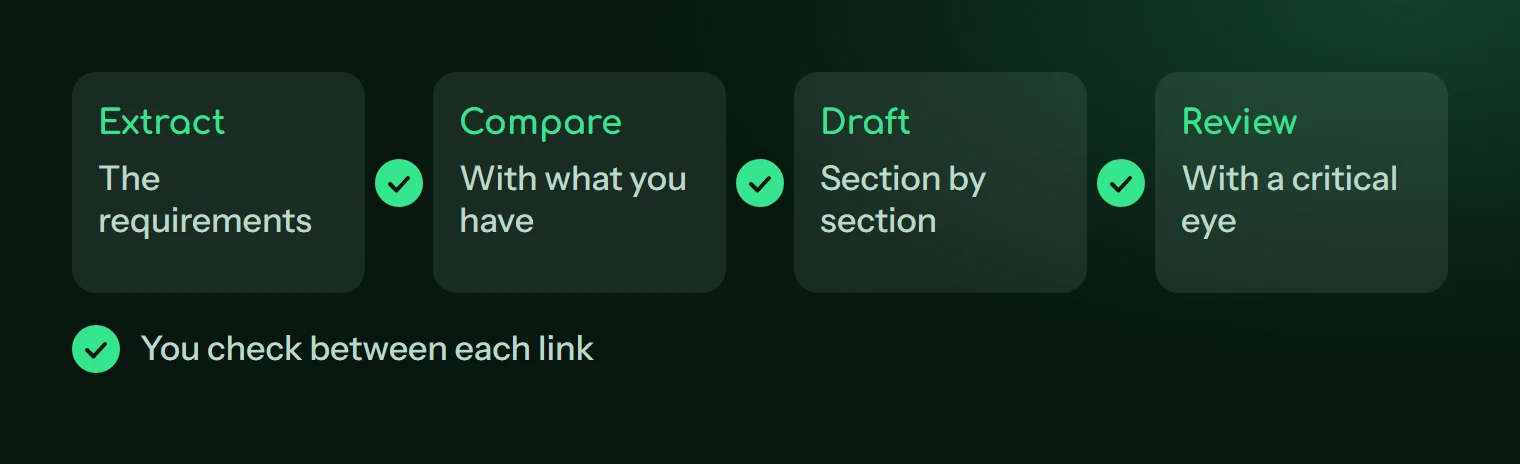
Prompt chaining solves this. You split the work into small steps, the output of one becomes the input of the next, and you check in between. Each prompt has just one thing to do well.
Spot where to cut
A task is worth splitting when it mixes different kinds of operations. Extracting information, deciding on an outline, drafting, and critiquing call for opposite attitudes: you want zero creativity in the extraction and plenty of rigor in the review.
A good cutting point answers a simple question: can I check this intermediate result in under a minute? A list of criteria is quick to check. Twelve pages of drafted text, not so much. If two steps don't produce anything checkable between them, merge them: a chain of nine links will cost you more time than it saves. Three to five steps work for most office tasks.
The grant application, link by link
Let's go back to the nonprofit. The chain has four steps.
Link 1: extract what's required
Nothing gets written at this stage. The goal is to turn a fuzzy document into a list you can check.
Here is the text of a call for proposals. Build a table with three columns: criterion or requirement, document or information to provide, and the passage of the text that mentions it (exact quote).

Don't add any criterion that isn't in the text. At the end, flag any ambiguous points to clarify with the funder.

[CALL FOR PROPOSALS TEXT]
Check: compare the table to the document by going through the quotes. If a criterion is missing, add it by hand. This list is the reference for everything that follows, so a mistake here spreads everywhere.
Link 2: compare the table to what you have
Below are the requirements of a call for proposals, followed by my notes on our project.

For each requirement, tell me: covered by my notes, partially covered, or missing. For the last two cases, write the specific question I should ask my team.

Don't invent any information about the project.

REQUIREMENTS:
[VALIDATED TABLE FROM LINK 1]

NOTES:
[YOUR NOTES ON THE PROJECT, BUDGET, AUDIENCE, TIMELINE]
This is the link the single prompt skips, and it's the one that prevents figures from coming out of nowhere. You get the missing answers from your team and fill in your notes.
Link 3: draft section by section
You only move on to drafting here, and preferably one section at a time.
You're writing the "[SECTION NAME]" section of a grant application for [FUNDER].

Requirements to address in this section: [RELEVANT ROWS OF THE TABLE]
Available facts: [VALIDATED NOTES]
Length: [NUMBER] words maximum.

Style: simple sentences, action verbs, facts and expected results rather than statements of intent. Use only the facts provided. If a fact is missing, write [TO BE COMPLETED] in its place.
The [TO BE COMPLETED] tag gives the AI a permitted way out when something is missing. Without it, the model tends to guess.
Link 4: review through the funder's eyes
You're a grant reviewer for [FUNDER]. Below are the criteria from the call for proposals, followed by an application.

For each criterion, say whether it's addressed and where, and give a score from 1 to 3 with a one-line justification. Then list the claims in the application that aren't backed by any specific fact. Don't rewrite anything.

CRITERIA:
[TABLE FROM LINK 1]

APPLICATION:
[COMPLETE APPLICATION]
"Don't rewrite anything" keeps this pass in its critic role. You then decide which corrections to make. Obviously, this score doesn't predict the funder's decision; it's there to spot weaknesses in the text.
Passing information from one link to the next
Three habits make a chain reliable.
Pass along the validated result, not the whole history. If you corrected the table by hand, that version goes into the next link. Pasting in the entire previous exchange brings back the errors you already eliminated.
Choose between continuing and starting fresh. The same conversation works if the steps follow each other closely. For the final review, open a new conversation: fresh eyes, without the context of the drafting, judge better. On long projects, it also keeps you from filling up the conversation's memory, a topic covered in the article on tokens and the context window.
Lock down the intermediate formats. A table or a list with fixed labels passes along well. If you automate the chain, switch to structured JSON: a program reads a paragraph poorly.
When a chain isn't worth it
For an email or a one-page summary, splitting adds nothing. The warning sign is more like this: you keep fixing the same flaws in the same spot afterward. If you've already tried to improve your prompt through iteration without success, it's often because you're asking for too many things at once.
A chain doesn't eliminate proofreading either. A mistake you missed at the first link travels through all the others, looking more and more convincing.
Start with a two-link chain
Take your next writing task that runs longer than a page. In a first prompt, ask only for a list of points to cover and missing information. Correct that list, then ask for the text based on it. A single cut is enough to see where the gain lies for your kind of work.
Read next
Advanced techniques
Telling AI What Not to Do: Does It Work?
"Don't use the word artisanal" and the word comes back. When a negative instruction holds, when it fails, and how to rephrase or check it.
3 min read

Advanced techniques
Ask for Three Versions, Then Choose
A single answer forces you to accept or refuse. Three well-framed, genuinely different versions let you compare. The prompt and how to decide.
3 min read

Advanced techniques
Extracting information from messy text
Email replies, meeting notes, WhatsApp messages: how to pull dates, names, and decisions out of disorganized text, with the evidence for every line.
4 min read