

 Français
 Español
 Deutsch
 Italiano
 Português
Anatomy of a Good Prompt: The 6 Elements That Matter
Task, context, material, constraints, format, example: we build a prompt piece by piece on a real case, with a blank template to fill in.
"Write a message announcing that the membership fee is going up." That request contains a task and nothing else. So the AI will invent the reason for the increase, pick a tone at random, and hand back a text that looks like every club letter ever written.
A good prompt leaves little to guess, and six elements cover almost everything there is to say. We'll put them together one at a time using the case of a judo club treasurer, looking at what each one adds and when you can do without it. If you're starting from scratch, begin with our guide to what a prompt is.
The task: a precise verb and a deliverable
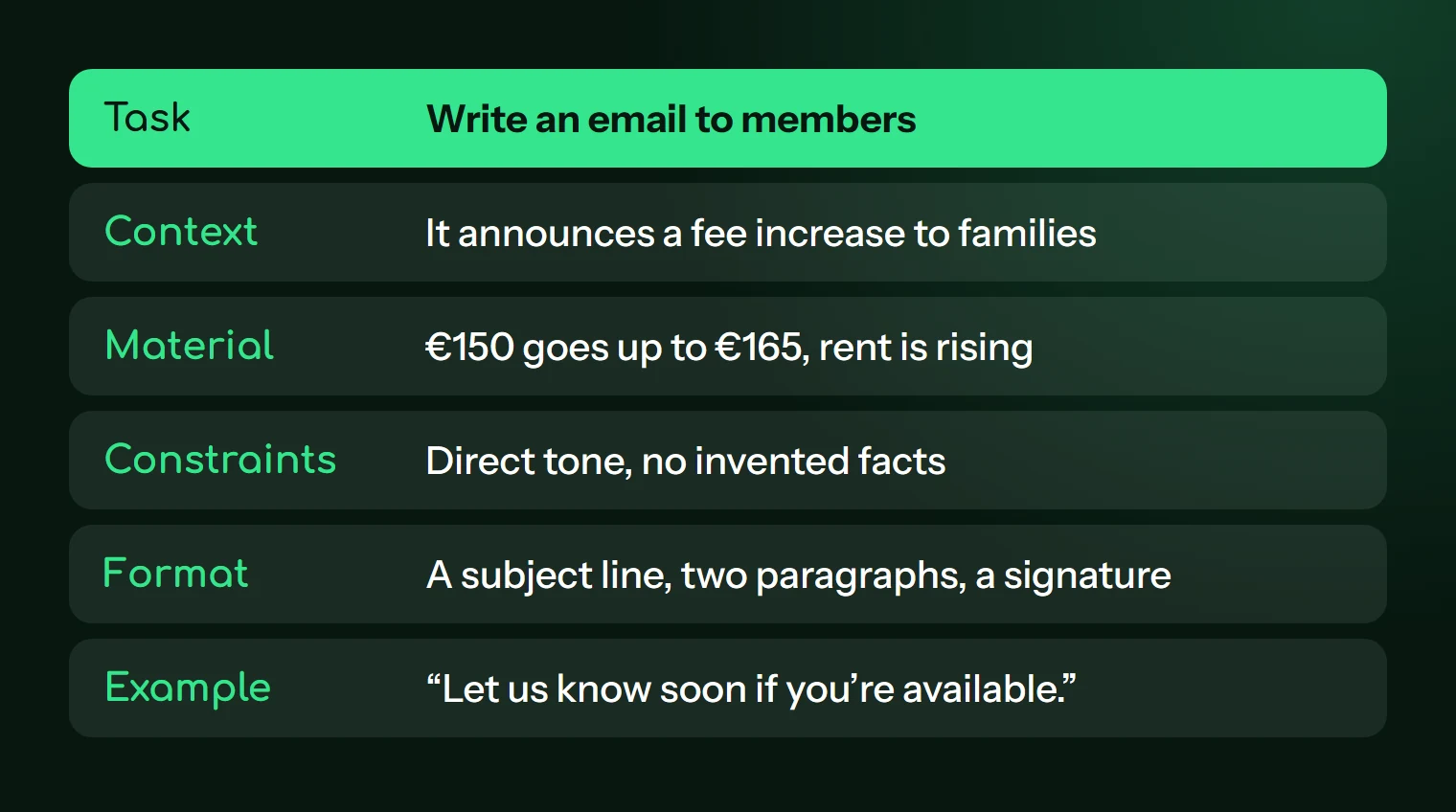
This is the only mandatory element. It says what the AI should produce, with a clear verb and an identifiable object. "Tell me about the membership fee" doesn't describe any work. "Write an email to the members" does.
Watch out for soft verbs like help, look at or improve. "Improve this text" could mean shorten it, correct it or change its tone, and the AI will decide for you. "Fix the typos without touching the style" doesn't leave it that choice.
Write an email to the club's members announcing the increase in the membership fee.
The context: the situation the text will land in
The context describes who will read it, why now, and what's at stake. An increase announced to parents who have been loyal for ten years isn't written the same way as one announced to adults who compare prices with the gym next door.
We're a small nonprofit judo club run by volunteers. Our readers are mostly parents of enrolled children. Some families have modest incomes, and we're worried about people leaving.
The last sentence matters most here. It tells the AI what the author is really worried about, and therefore which objection to address. To decide what to include and what to leave out, read our article on the context to give the AI.
The material: the facts the AI can't invent
This is the element people forget most often, even though leaving it out produces the worst results. Without the real numbers, the AI makes some up, or fills the gap with empty phrases like "in light of rising costs."
The material is your raw data: amounts, dates, names, loose notes, an old letter. You don't need to write it up nicely. A list is enough, kept separate from the rest so the AI knows it's its source.
Facts to use: annual fee going from €150 to €165 at the start of the new season; higher dojo rent and replacement of the mats; last increase four years ago; payment in three installments possible, on request from the treasurer.
The constraints: what has to be respected
Constraints set the limits: tone, vocabulary, what to avoid, language. Two or three are usually enough. Beyond that, some of them risk getting dropped.
Phrase them positively whenever you can. "Not too formal" stays vague, whereas "write like a volunteer talking to parents he runs into at the edge of the mat" gives a precise picture.
Direct, respectful tone, without apologizing several times. Don't use the words "context" or "difficult." Don't add any fact that isn't in the list.
That last instruction matters: it lowers the risk of the AI embellishing, without eliminating it. You'll still need to proofread.
The format: the exact shape of the result
With no guidance, the AI picks a default shape, often too long. Specify the length, the structure, and anything you want to receive besides the text.
Format: an email subject line under 8 words, then a body of two short paragraphs at most, then a sign-off "The club board."
The useful settings, like tables or lists, are covered in our article on how to impose an output format.
The example: showing what adjectives describe poorly
A short sample beats a long description of the tone. You can paste an old email you liked, or a single sentence written in your own hand.
Example of the tone I want: "The June tournament is coming together, and we need extra hands to run the snack bar. Let us know soon if you're free."
For a simple task, it's the only one of the six elements that's truly optional. It becomes valuable when style matters, or when the result has to follow a form you find hard to explain. This technique has a name: few-shot.
The complete prompt, and when to trim it
Put together, the prompt looks like this. It reads in a minute and takes barely longer to write.
Write an email to the club's members announcing the increase in the membership fee.

Context: we're a small nonprofit judo club run by volunteers. Our readers are mostly parents of enrolled children. Some families have modest incomes, and we're worried about people leaving.

Facts to use:
- annual fee: going from €150 to €165 at the start of the new season
- reason: higher dojo rent and replacement of the mats
- the last increase was four years ago
- payment in three installments possible, on request from the treasurer

Constraints: direct, respectful tone, without apologizing several times. Don't use the words "context" or "difficult." Don't add any fact that isn't in the list.

Format: an email subject line under 8 words, then a body of two short paragraphs at most, then a sign-off "The club board."

Example of the tone I want: "The June tournament is coming together, and we need extra hands to run the snack bar. Let us know soon if you're free."
Here's the blank version to keep handy:
[TASK: precise verb + what should be produced]

Context: [who will read or use the result, in what situation, what's at stake]

Material to use:
[facts, numbers, notes or document]

Constraints: [tone, vocabulary, what to avoid]. Don't add any fact that isn't in the material provided. If a piece of information is missing, flag it instead of inventing it.

Format: [length, structure, expected elements]

Example of what I want: [short sample, optional]
Not every prompt needs all six elements. This table helps you scale up or down depending on what a mistake would cost.
| Situation | Elements needed |
|---|---|
| Quick question, nothing at stake | Task only |
| Rewrite or correct a text | Task, material, constraints |
| Text sent to real people | Task, context, material, constraints, format |
| Text in your style or a required format | All six |
You may have noticed that the role ("you are an expert in...") is missing from the list. It's often cited first, yet it adds far less than context or material, and sometimes nothing at all. That topic deserves its own read: when giving the AI a role really helps.
For practice, take your last disappointing prompt and run it through the blank version. It's probably missing the material or the context: add that one element alone, send the request again and see what changes.
Read next
Getting started
Using AI at work: where to start
Company rules, a first low-risk task, data you shouldn't paste, measuring your trials: a six-step plan for getting started without a misstep.
4 min read
Getting started
What Context to Give AI to Get Good Answers
Too little context and the AI makes things up, too much and it loses the thread. The test to apply to each piece of information, with examples and a reusable template.
5 min read

Getting started
Giving the AI a Role: When It Helps, When It's Pointless
"You are an expert with 20 years of experience" doesn't add any skill to the AI. What a role really changes, and how to write one that's worth having.
5 min read